Where does a digital tip go? Follow £10 to the bank
With TipBop a digital tip goes straight to the worker's own Stripe account. It does not go through the till, the venue or TipBop. On a £10 tip the customer pays £10.80 and the worker receives £10.00. Payouts reach their bank once £20.00 has built up, or by the next payout date.
Follow £10 from the phone to the bank
Say a customer tips £10 to Amara, a fixture worker we use in screenshots. Here is the whole journey.
| Step | What happens | Amount |
|---|---|---|
| 1 | The customer taps the tag and chooses £10 on Amara's page. | £10.00 |
| 2 | The page shows the total before they pay. | £10.80 |
| 3 | They pay with Apple Pay, Google Pay or a card. Stripe takes the payment. | £10.80 |
| 4 | The payment lands in Amara's own Stripe account. | £10.80 |
| 5 | Our fee is collected from that payment as it happens. | £0.80 |
| 6 | Amara's balance goes up by exactly what the customer chose. | £10.00 |
| 7 | Once her balance reaches £20.00, it is paid out to her bank. | £20.00 or more |
Nothing in that list is a till, a pot or a payroll run. The venue is not a step.
Whose money is it, and who holds it
The payment is made to a Stripe account in the worker's own name. That makes the worker the party who receives the payment. It is their money from the moment it is paid, not ours to pass on.
We built it this way on purpose. TipBop never holds a balance of anyone's tips. There is no TipBop wallet, no float and no pot waiting to be shared out. If we wanted to hold a tip back, we could not, because we never have it.
Stripe, the payment company, handles the card details. They go straight to Stripe and never touch TipBop, and we never see or store a card number.
This also answers a question people ask about venues. Because the payment is made to the worker and not to the business, it does not go through the till and nobody divides it up afterwards. What the guidance for venues says is a separate question, and what a venue does with digital tips covers it.
The fee, and who pays it
The customer pays our fee, on top of the tip. It is 40p plus 4% of the tip, with no cap. The smallest tip is £2.00 and the largest is £250.00. It is the same fee on every way of paying.
On a £5 tip the customer pays £5.60 and the worker receives £5.00. On £10 the customer pays £10.80 and the worker receives £10.00. The fee is never taken out of the worker's tip.
Stripe charges for handling a card payment. That charge is ours to carry, not the worker's, and it is part of why the fee has no cap: a cap would stop covering the cost on bigger tips. The reasoning is written up at the customer pays the fee. We do not repeat the arithmetic here.
When it reaches the bank
A tip shows in the worker's app the moment it is paid, before it reaches the bank, so they can see what is on its way.
Money is paid out to the bank account the worker chose once £20.00 has built up, or by the next payout date shown on their Money screen. It usually lands the next working day after the payout is sent. The screen below is from a test-mode account, so the bank it names is Stripe's test bank and the figures are sample data, not a real payout. It shows the floor and the date.
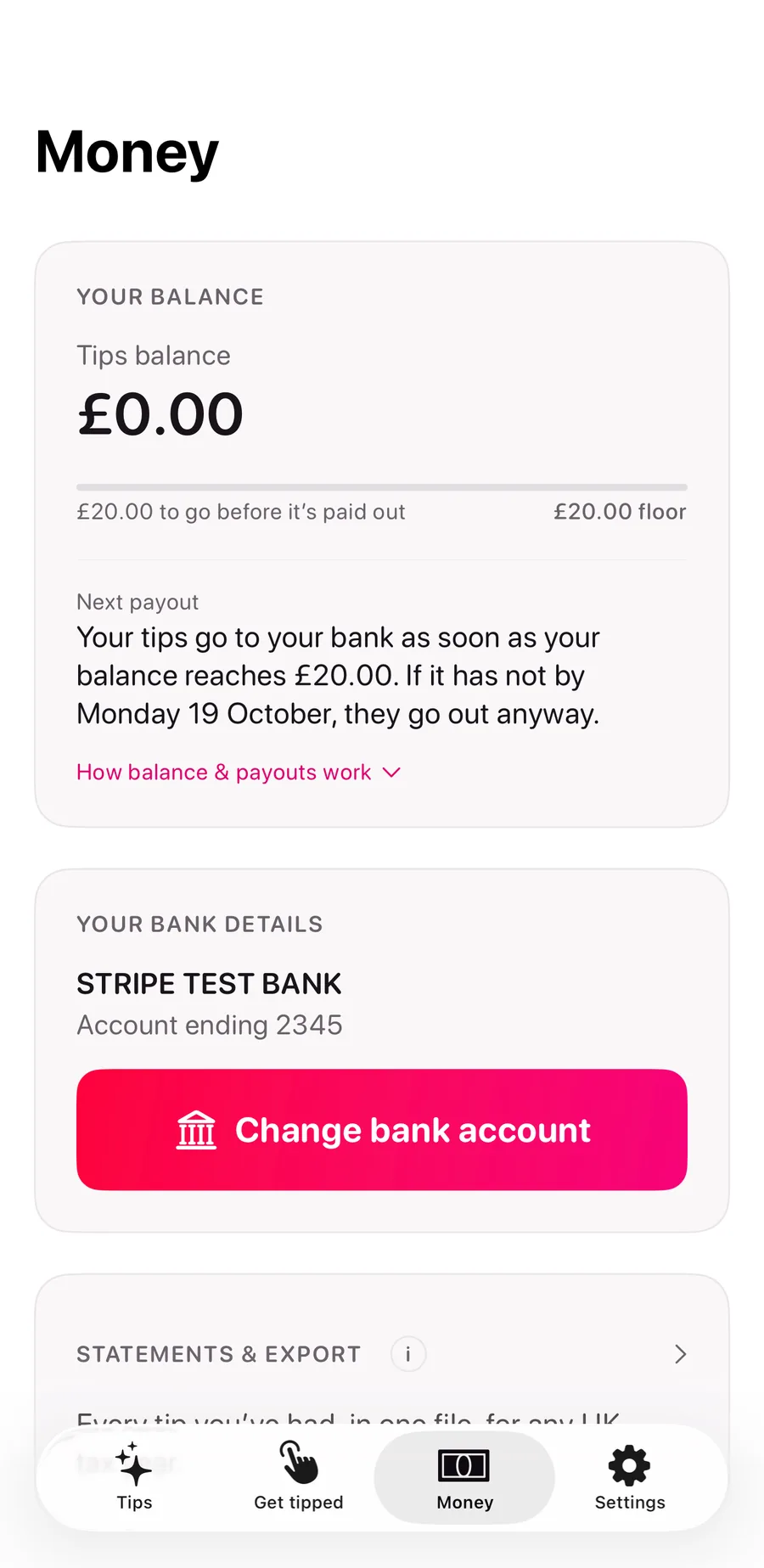
The £20.00 floor is there because sending one small tip to a bank on its own can cost more than the tip is worth, so small tips wait for company. Nothing waits for ever: anything still sitting after a month goes out anyway.
What this guide does not tell you
It describes where a tip goes. It is not tax or legal advice. A worker's tips are their own income to declare, and TipBop's yearly statement lists them for that purpose. TipBop does not file anything, withhold anything or give tax advice.
If you are the person who tapped and want to know what happens on your side, the tipping page covers it. If you are a worker deciding whether to sign up, how it works and the questions page are the places to start. For the tap itself, see how a tap becomes a tip.
Questions
Does a digital tip go through the till?
Not with TipBop. The payment is made to a Stripe account in the worker's own name, not to the business they work for and not to us. It does not pass through the till, a tronc or payroll, and nobody divides it up afterwards. We say more about venues in the guide on what a venue does.
Does TipBop hold the money?
No. There is no TipBop balance and tips never pass through one. The customer's payment is made to the worker's own Stripe account, and our fee is collected from that payment as it happens. We could not hold a tip back, because we never have it. The footer of every page says it too.
How much of the tip does the worker get?
All of it. The customer pays our fee on top, so on a £10 tip the customer pays £10.80 and the worker receives £10.00. The fee is 40p plus 4% of the tip, with no cap, and it is shown to the customer before they pay.
When does a tip reach the worker's bank?
Once £20.00 has built up, or by the next payout date, whichever comes first. It usually lands the next working day after the payout is sent. A tip appears in the worker's app as soon as it is paid, so they can see it before it reaches the bank.
Sources
- TipBop, Tipping somebody with TipBop (read 17 November 2026)
- TipBop, Questions (read 17 November 2026)
- TipBop, How it works (read 17 November 2026)
- TipBop engineering record: the money flow document (Stripe Connect direct charges, the worker as merchant of record, no TipBop balance)
- TipBop engineering record: the fees decision (customer pays 40p plus 4%, no cap, minimum £2.00, maximum £250.00) and the money invariant tests
- TipBop production settings: payout minimum of £20.00
- Stripe, Direct charges (read 17 November 2026): how a payment can be made straight to a connected account
- Stripe, Payouts to connected accounts (read 17 November 2026): how a balance is paid to a bank account
- HMRC, When National Insurance and PAYE is due on tips, gratuities and service charges (E24) (read 17 November 2026): background on how tips are treated for tax
Keep reading
Your tips. Your bank account. Nobody in between.
Install app